America’s entertainment industry didn’t just stumble – it packed up and left. Film and television production, born right here in the United States and once the undisputed global heavyweight, has been migrating steadily to Canada, the United Kingdom, and a growing roster of countries happy to undercut us. It’s a pattern conservative Americans recognize instantly. Foreign competitors dangle better deals. Washington shrugs. American workers pay the price.
And make no mistake – this is a working-class story. Behind every film set are teamsters hauling equipment, electricians wiring soundstages, carpenters framing sets, and small businesses feeding hungry crews. Tens of thousands of jobs hang in the balance. Not glamorous jobs. Real ones. So when something actually shifts in Washington on this front, it deserves attention – especially when the shift comes from a direction nobody saw coming.
From Breitbart:
President Donald Trump’s personal drive to bring film and television back to the U.S. was applauded Tuesday by three major unions representing Southern California entertainment workers.
Trump’s leadership on tax incentives came in for special praise in an industry currently struggling to secure its future against increasing foreign competition and the growth of artificial intelligence (AI).
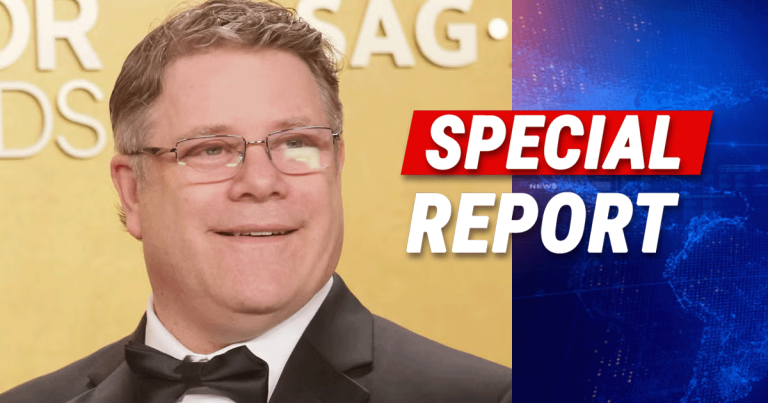
Well. That’s not a sentence you hear every day. Three major entertainment unions – SAG-AFTRA, the International Alliance of Theatrical Stage Employees, and Teamsters Local 399 – standing up to publicly applaud President Donald Trump. Leading the pack? SAG-AFTRA president Sean Astin. Yes, that Sean Astin – Samwise Gamgee himself, beloved star of The Lord of the Rings, The Goonies, and Stranger Things. Astin, alongside national executive director Duncan Crabtree-Ireland, praised Trump’s “vocal and determined leadership” and declared that “calling for federal production incentives is exactly what the entertainment industry needs.”
A prominent Hollywood union president expressing gratitude toward this particular president. In an industry that has spent years treating Trump like a villain in one of its own scripts, the moment borders on surreal.
A coalition that defies the script
Astin grabbed the headlines, but he had plenty of company. Teamsters president Sean O’Brien publicly thanked Trump and his administration “for prioritizing passage of a federal film tax credit,” pointing out that his union represents tens of thousands of workers whose paychecks depend on domestic production. The Motion Picture Association wasn’t far behind – chairman Charles Rivkin endorsed the plan, arguing it could funnel production into communities across all fifty states.
Then there’s IATSE, representing over 170,000 entertainment workers, which confirmed it’s actively collaborating with Trump’s Hollywood ambassador Jon Voight and congressional lawmakers on a federal incentive framework. Even House Democrats Pete Aguilar and Ted Lieu – both from California – voiced support for the concept. That’s worth pausing on. A Trump proposal drawing bipartisan enthusiasm before a single line of bill text has been released speaks to a policy with genuine gravitational pull.
The art of leverage
This broad alignment didn’t materialize out of thin air. A year ago, Trump floated a 100 percent tariff on films produced offshore. The industry panicked. Producers and studio heads who’d happily ignored Washington suddenly had a very compelling reason to engage. That tariff threat functioned as a masterclass in negotiation – vintage Trump, frankly.
His Truth Social post on Monday drove the point home with characteristic bluntness: “What we watch on the Silver Screen should be made in what was once the Movie and Motion Picture Capital of the World. Let’s get this done!”
The proposed Motion Picture, Television, and Entertainment Revitalization Act still lacks formal bill text and cost projections. Congress has work ahead. But the political foundation is poured, and the coalition supporting it is broader than anyone – especially Hollywood – would have predicted six months ago.
More than movies
Strip away the celebrity names and union acronyms, and a deeper truth emerges. This is about whether America still produces its own culture or farms it out to the lowest bidder overseas. When our stories get filmed on foreign soil by foreign crews, we lose something concrete – jobs, tax revenue, community investment – and something harder to quantify. National identity. Pride of craft.
The generation that grew up when “Made in Hollywood” meant something understands this instinctively. President Trump grasped what his predecessors wouldn’t: sometimes bringing an industry home requires a leader willing to throw his weight around, even in rooms where his name gets hissed.
When the result is union bosses, studio executives, and Democratic lawmakers all lining up behind the same proposal, it validates a principle conservatives have championed for years. Sound policy doesn’t require Hollywood’s blessing.
But watching them offer it voluntarily? That’s just gravy.
Key Takeaways
- Trump’s federal film incentive united Hollywood unions, studios, and even Democrats behind his leadership.
- Tens of thousands of working-class entertainment jobs hinge on bringing production back to American soil.
- Trump’s 100 percent tariff threat last year forced a hostile industry to the negotiating table.
- Good policy transcends partisan loyalties – and Hollywood just proved it.
Sources: Breitbart