America’s asylum system isn’t broken. It was sabotaged. What started as a narrow legal protection for genuine refugees — people fleeing real persecution — got hijacked by progressive lawyers, activist judges, and open-border politicians who turned it into a universal entry ticket. Show up at the southern border, say the word “asylum,” and suddenly the full weight of the U.S. legal system is working to keep you here. Millions figured that out. Who could blame them?
But the deeper problem was never just the volume of people. It was the legal architecture underneath. For years, immigration advocates pushed a radical interpretation of federal law: that merely walking up to a port of entry — while still standing on Mexican soil — entitled a foreign national to full asylum processing inside the United States. Think about that for a second. You haven’t crossed the border. You haven’t entered the country. But somehow, you’ve “arrived.” It was a legal fiction so absurd that it could only survive in a system nobody was willing to challenge. Until now.
From The Post Millennial:
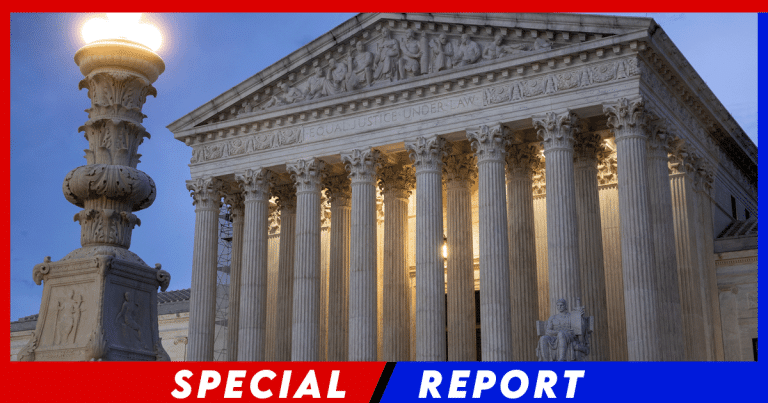
The majority of Supreme Court justices appeared to be sympathetic to the idea that the Trump administration should be able to turn away asylum seekers at the US-Mexico border. If the court rules in favor of the administration, the government will be able to revive a policy used during Trump’s first term, where those seeking asylum were stopped at the border from setting foot in the US.
Federal law dictates that those who arrive in the US and are “physically present in the United States” or “arrive in the United States” can apply for asylum. The issue is whether noncitizens merely have to show up to the border to request asylum or if they have to cross the border fully before applying.
The legal question that could change everything
Let’s be clear about what the Supreme Court is actually deciding here. The case revolves around a policy called “metering” — the practice of allowing border officials to pause asylum processing when ports of entry are overwhelmed. The Trump administration’s lawyer, Vivek Suri, didn’t mince words: “You can’t ‘arrive in the United States’ while you’re still standing in Mexico. That should be the end of this case.”
Justice Amy Coney Barrett drove the point home, pressing the immigrant advocacy group’s attorney on what “arriving” even means. “If it’s not crossing the physical border, what is the magic thing?” she asked. Good question. Only Justices Sotomayor and Jackson seemed inclined to side with the open-processing position. On a court with a 6-3 conservative majority, that’s not exactly a winning coalition.
The wreckage Biden left behind
Context matters here. When Biden rescinded the metering policy in 2021, he didn’t just open a door. He removed the door from its hinges. Millions of illegal immigrants poured across the southern border. Immigration hearings got scheduled five or more years into the future — a timeline so laughable it functioned as a wink and a nod. At one point, the administration simply dismissed cases wholesale. No legal status. No deportation orders. Just bureaucratic shrugging dressed up as compassion.
Even Barack Obama — no one’s idea of a border hawk — recognized the need for metering, initiating the policy in 2016 during a migrant surge. When you’ve lost Obama on the issue, maybe it’s time to rethink your position.
A court that’s finally catching up
Here’s what makes this case genuinely exciting. It’s not an isolated event. The Supreme Court has already backed Trump on deporting migrants to third countries and revoking temporary legal status for Venezuelan migrants. Next week, the justices hear arguments on birthright citizenship. Next month, they will take up protections for hundreds of thousands of Haitians and Syrians. That’s not a one-off. That’s a pattern.
A favorable ruling in this case — expected by June — wouldn’t just validate metering. It would hand the administration a court-sanctioned instrument to control the border at its most fundamental pressure point. The government would finally have the explicit legal authority to say: you don’t get to claim you’ve arrived in America when you’re standing in Tijuana.
For anyone who understands that a country without the power to control its own borders has surrendered something irreplaceable, this case matters. Not as symbolism. Not as political theater. At the moment, the legal system has stopped pretending that words don’t mean what they say.
Key Takeaways
- The Supreme Court appears ready to let Trump block asylum claims at the border.
- The “metering” policy would give border agents real authority to manage asylum processing.
- Biden’s removal of border enforcement tools led to millions of illegal crossings.
- This case is part of a broader pattern of SCOTUS siding with Trump on immigration.
Sources: The Post Millennial, Reuters