For decades, American presidents approached China as though Beijing were doing us a favor by engaging. Summits were cautious, stage-managed affairs – choreographed by State Department careerists more concerned with offending the Chinese Communist Party than defending American workers. Shocking absolutely no one, China grew bolder, wealthier, and more aggressive while Washington smiled and watched its industrial base get stripped for parts.
Donald Trump has never operated that way. From his first term through his second, he has grasped something his predecessors couldn’t – or wouldn’t. The U.S.-China relationship isn’t a friendship to be tended. It’s a rivalry to be won. And how you greet your competitor matters just as much as what you negotiate across the table.
From the Daily Wire:
President Donald Trump rolled out the red carpet for Chinese President Xi Jinping on Wednesday, before sending two B-1 bombers roaring overhead as the Chinese leader arrived in Washington for a three-day state visit.
Xi and his wife, Peng Liyuan, landed at Joint Base Andrews shortly before 6 p.m. Trump and first lady Melania Trump were waiting at the bottom of a roughly 100-foot red carpet to greet them, an unusual gesture for a sitting U.S. president.
XI JINPING APPEARED UNABLE TO EVEN LIFT HIS HEAD
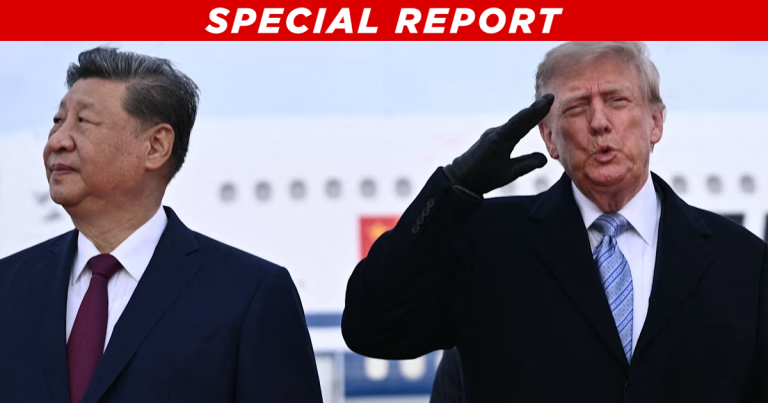
As the U.S. fighter jet flew over Trump and Xi Jinping, Trump reacted immediately with a “Wow!” and appeared visibly proud.
Xi Jinping, by contrast, appeared to keep his eyes gently closed, as if he were simply… pic.twitter.com/4R21ztefAl
— DooriDoori (@DooridooriX) September 24, 2026
Consider the full scope of what Trump orchestrated here. He didn’t just break with tradition by personally traveling to the airport – something sitting presidents simply don’t do for arriving foreign leaders. He rolled out a 100-foot red carpet. A 21-person honor cordon. Color guards carrying both nations’ flags. A military band. Both national anthems. It was, by any measure, the most generous reception Xi Jinping has received anywhere in over a decade.
Then the sky opened up.
Two B-1 Lancers – supersonic heavy bombers built to project American dominance across continents – screamed overhead as the Star-Spangled Banner played and Trump stood saluting. The roar was intense enough that the president visibly winced before flashing a grin. Xi didn’t flinch. Good poker face. But the message needed no translation: Welcome to America. You are honored here. And you should never, ever forget what stands behind us.
First Lady Melania Trump framed it beautifully. Xi was “coming on our soil,” she told reporters, and America should “welcome them with the most respect.” Hospitality and sovereignty in one breath. That’s a balance previous administrations never figured out.
The asymmetry says everything
Here’s what makes the whole display even sharper. When Trump visited Beijing back in May, Chinese Vice President Han Zheng met him at the airport. Respectable enough – but a deliberately subordinate figure. Beijing’s quiet message was clear: You matter, but don’t overestimate how much.
Trump’s countermove? He didn’t match Xi’s diplomatic understatement. He buried it. He went to Andrews himself, brought Melania, deployed every military honor available, and punctuated the whole thing with a flyover that probably registered on seismographs. That’s not bluster. That’s a leader who knows his leverage and wants the other side to feel it in their chest.
What the bombers were really about
The theatrics at Andrews weren’t decoration. They were prelude. The summit agenda reads like a checklist of the most consequential issues on Earth: artificial intelligence, trade, rare-earth minerals, Taiwan, and China’s stubborn economic lifeline to Iran. A fragile trade truce between the two nations expires in November, and neither side is bluffing about what comes next.
Trump has boiled the AI competition down to six words: “Whoever wins AI wins.” His administration has choked off exports of advanced AI chips to China. Beijing hit back by restricting critical mineral supplies that American manufacturers depend on. Both governments are blacklisting each other’s companies while still trying – awkwardly – to keep diplomatic channels open.
Senator Steve Daines, a Montana Republican who traveled to China to help prepare for the summit, offered a grounded perspective: “The fact that they are meeting, and there’s dialogue occurring and building that relationship, is probably as important as outcomes from the meeting.”
Fair point. But dialogue carries a different weight when one side just reminded the other what a B-1 sounds like at treetop level.
The road ahead
November’s trade deadline will reveal whether this summit produced anything lasting. Taiwan remains a flashpoint. Iran’s oil trade with Beijing threatens to undercut Trump’s maximum-pressure campaign. None of those problems get solved by a flyover alone.
But they certainly don’t get solved by weakness. Conservatives have understood for generations that peace is purchased through power – not through diplomatic hand-wringing and polite concessions. Trump greeted Xi Jinping the way America should greet any great-power rival: with genuine warmth, an open hand, and the unmistakable thunder of American muscle overhead.
Key Takeaways
- Trump shattered presidential norms by greeting Xi at the airport – then topped it with a B-1 bomber flyover.
- The lavish welcome paired with raw military power sent one message: respect without submission.
- AI supremacy, trade, and Taiwan hang over a fragile truce expiring in November.
- Peace through strength remains the only language great-power rivals truly understand.
Sources: Daily Wire, AP News